
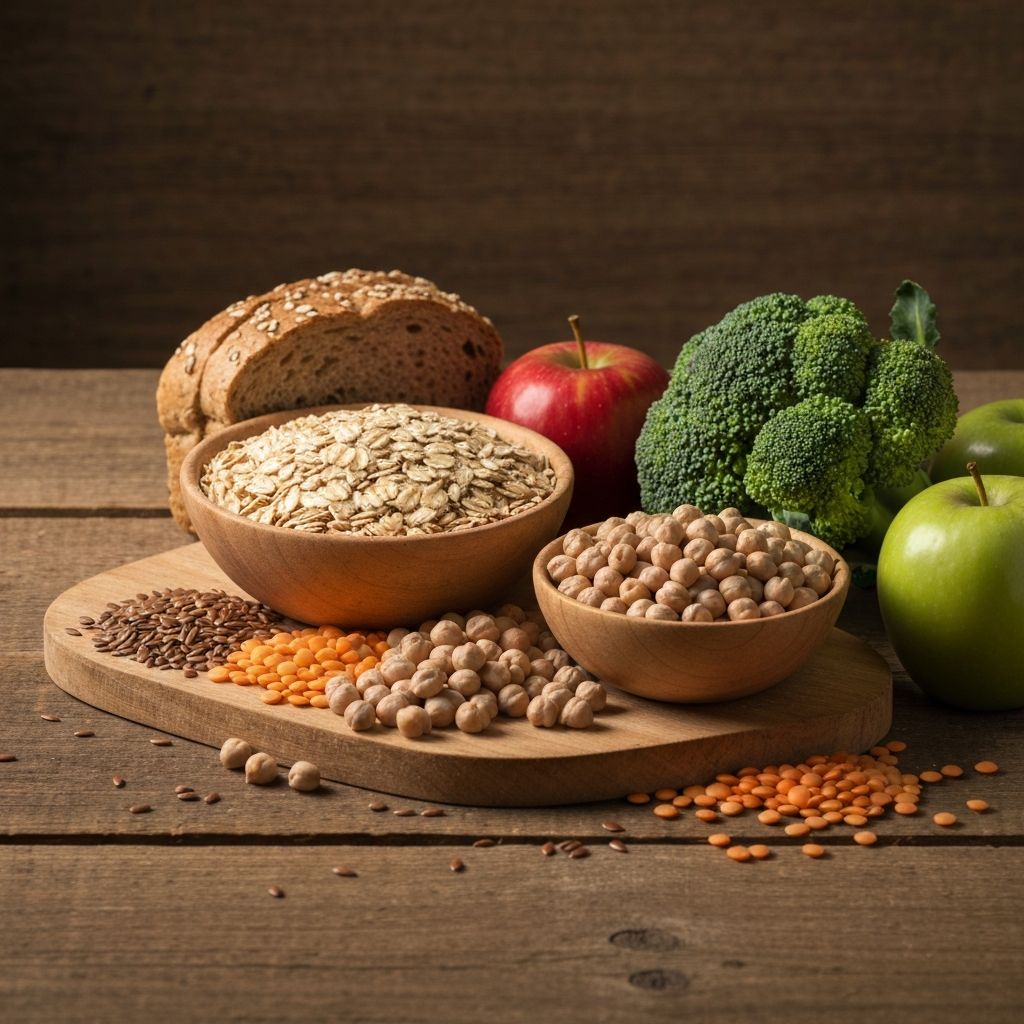
Dietary fibre occupies a distinctive position in nutritional science. Unlike carbohydrates, proteins, and fats, fibre is not broken down and absorbed by the human digestive system in a conventional sense. Yet its presence — or absence — in the diet has significant implications for digestive physiology, gut ecology, and the broader internal environment of the gastrointestinal tract.
What Is Dietary Fibre?
Dietary fibre is broadly defined as the indigestible components of plant-derived foods — primarily polysaccharides and lignin — that pass through the small intestine largely intact. Human digestive enzymes lack the ability to hydrolyse the beta-glycosidic bonds that link the monosaccharide units in most fibrous polysaccharides (such as cellulose), which is why they reach the large intestine undigested.
The category is not monolithic. Fibres differ substantially in their physical properties, their behaviour in the digestive tract, and the extent to which they are fermented by the colonic microbiota. The primary classification distinguishes between soluble and insoluble fibre, though many plant foods contain a mixture of both.
Soluble Fibre: Properties and Mechanisms
Soluble fibre dissolves in water to form a viscous gel in the gastrointestinal tract. This gel-forming property is central to its physiological effects in the upper digestive system. Key types include:
- Beta-glucans — Found in oats and barley. These polysaccharides are among the most studied fibres, forming a viscous solution in the small intestine that slows the transit of digesta and modulates the rate at which nutrients are absorbed.
- Pectins — Present in the cell walls of fruits and some vegetables. Pectins are highly fermentable and are broken down extensively by colonic bacteria.
- Inulin and fructooligosaccharides (FOS) — Found in garlic, onions, chicory, asparagus, and Jerusalem artichokes. These are classified as prebiotics — compounds that selectively stimulate the growth or activity of beneficial bacteria in the colon, particularly Bifidobacterium species.
- Psyllium husk — Derived from the seeds of Plantago ovata. Psyllium is notable for its high water-holding capacity and is one of the most viscous dietary fibres known.
In the small intestine, the gel matrix formed by soluble fibre creates a physical barrier that slows the digestion of starch and fat and delays glucose absorption. In the large intestine, soluble fibres are fermented by anaerobic bacteria into short-chain fatty acids (SCFAs) — primarily acetate, propionate, and butyrate. These SCFAs are then absorbed by colonocytes (the epithelial cells lining the colon).
Short-Chain Fatty Acids: Products of Fermentation
The fermentation of soluble fibre by colonic bacteria produces short-chain fatty acids (SCFAs) — notably butyrate, propionate, and acetate. These compounds serve as the primary energy source for colonocytes (the cells lining the colon wall). Butyrate, in particular, has been a subject of considerable scientific interest: it is preferentially oxidised by colonocytes, contributing to the maintenance of the intestinal barrier. The production of SCFAs also lowers the pH of the colonic environment, creating conditions that are less hospitable to certain potentially pathogenic bacterial species and more favourable to acid-tolerant beneficial bacteria.
It is important to note that while SCFA research is scientifically compelling, translating these mechanistic observations into specific health claims requires caution. The relationship between fibre intake, SCFA production, and human health outcomes is complex and continues to be investigated.
Insoluble Fibre: Bulk, Transit, and Structural Roles
Insoluble fibre does not dissolve in water and remains relatively intact as it passes through the digestive tract. Rather than forming a gel, insoluble fibre adds physical bulk to intestinal contents and influences the mechanics of digestion in different ways.
- Cellulose — The most abundant organic polymer on Earth and the principal structural component of plant cell walls. Found in all plant foods but particularly concentrated in the bran layers of grains, the stems and stalks of vegetables, and the skins of legumes and seeds.
- Hemicellulose — A diverse group of polysaccharides found alongside cellulose in plant cell walls. Some hemicelluloses are partially fermentable.
- Lignin — A complex aromatic polymer found in woody plant material, the husks of seeds, and mature vegetables. Lignin is not a polysaccharide and is essentially non-fermentable.
By adding bulk to the intestinal contents, insoluble fibre stimulates peristalsis — the rhythmic muscular contractions that propel material through the gastrointestinal tract. This mechanical stimulation influences transit time through the colon. A faster transit time means that intestinal contents spend less time in the colon, which has implications for the concentration and contact time of various compounds with the colonic wall.
Fibre-Rich Food Sources: A Practical Overview
| Food Category | Examples | Predominant Fibre Type |
|---|---|---|
| Whole grains | Oats, barley, rye, whole wheat, brown rice | Mixed (beta-glucans prominent in oats/barley) |
| Legumes | Lentils, chickpeas, black beans, split peas | Mixed soluble and insoluble |
| Vegetables | Broccoli, carrots, artichokes, onions, garlic | Mixed (inulin/FOS in onion family) |
| Fruits | Apples, pears, berries, citrus | Mixed (pectins prominent in apples/citrus) |
| Nuts and seeds | Flaxseeds, chia seeds, almonds, sunflower seeds | Mixed (psyllium in plantago seeds) |
Satiety and the Food Matrix Effect
Fibre influences how satisfying a meal feels. Both the physical bulk of insoluble fibre (which contributes to stomach distension, a mechanical signal of fullness) and the viscosity of soluble fibre (which slows gastric emptying and nutrient absorption) play roles in this effect. The broader food matrix — the physical structure of whole foods in which fibre is embedded — also matters: intact plant foods require more chewing than processed equivalents, which itself has implications for digestive signalling.
The concept of the food matrix highlights why consuming fibre as part of whole foods may produce different physiological responses than consuming equivalent amounts of extracted fibre supplements. The cell walls of intact plant tissue, the water content, the associated proteins and phytochemicals, and the physical form all interact. This is an area of active nutritional research, and the science does not yet provide simple universal conclusions.
Context and Limitations
This article describes the science of dietary fibre for educational purposes. It does not constitute dietary advice and does not make recommendations for specific fibre targets or food choices for individuals. Digestive physiology varies between individuals and is influenced by many factors including the composition of the gut microbiota, health status, medications, and overall dietary pattern. Not a medical product. Consult a doctor before making any dietary or health-related changes.